
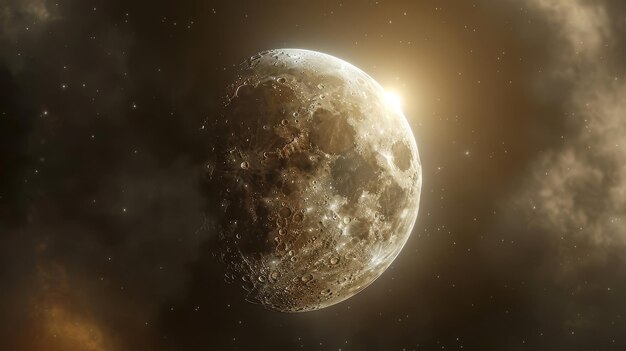

The celestial ballet between the Earth and its luminous satellite, the Moon, is a spectacle that has captivated humanity for millennia. As the Earth casts its vast shadow across the Moon’s surface, a magnificent transformation unfolds, giving birth to the phenomenon known as a partial lunar eclipse. The Earth’s shadow encroaches like a silent specter, cloaking a portion of the Moon in a shroud of darkness that contrasts sharply with its usual silvery glow.
During this event, stargazers and astronomers alike are drawn to the skies, witnesses to a majestic interplay of light and shadow. The Moon, often personified as a romantic symbol in various cultures, takes on a hauntingly beautiful visage as the Earth’s umbral shadow creeps over its rugged, cratered surface. It is as if the Moon is donning a theatrical mask, veiling its brilliance with the veil of twilight. The half-lit sphere, now partially obscured, becomes a canvas for a cosmic artwork, where science merges with the sublime.
The stripes of darkness emerge gradually, an intricate pattern that reveals the Moon’s texture more acutely. Each crater, valley, and highland stands out with an uncanny clarity as the light diminishes. Lunar enthusiasts often grab their telescopes and binoculars, eager to capture the exquisite details of this remarkable event. Indeed, the partial eclipse provides an unparalleled opportunity for amateur astronomers to witness and document the Moon’s often unnoticed imperfections illuminated by the remaining sunlight.
The phenomenon is not merely a visual wonder but also a moment of reflection. As we gaze upon the Moon, our thoughts transcend the terrestrial. We are reminded of our place in the cosmos, surrounded by infinite realms yet to be explored. The rhythmic dance of celestial bodies encourages a meditative state, inviting contemplation on the nature of existence and the secrets of the universe that dwell beyond our atmosphere.
As the Earth’s shadow retreats, the Moon reclaims its radiant glow; the cycles of waxing and waning are restored. The beauty of a partial lunar eclipse lies in this transitory nature — a reminder of life’s perpetual ebb and flow. It beckons us to witness, to marvel, and to appreciate the subtle shifts in our universe. For those fortunate enough to behold this grand spectacle, it is an invitation to contemplate the ephemeral in our lives, echoing the transient beauty of all things celestial.
